Tag: Smart Contracts

  • What Is a Reentrancy Attack in DeFi? Full Guide

    What Is a Reentrancy Attack in DeFi? Full Guide

    In the history of blockchain exploits, one vulnerability stands out as the most historically significant and economically damaging: the reentrancy attack. It was the exact vector used in 2016 to drain 3.6 million Ether from The DAO, forcing the Ethereum network to execute a controversial hard fork that split the chain into Ethereum (ETH) and Ethereum Classic (ETC). Even in 2026, reentrancy remains a common vulnerability in new Solidity smart contracts.

    For DeFi users and Web3 developers, understanding this vector is crucial. In this guide, we will break down what a reentrancy attack defi vector is, explain its mechanics using a simple code-free analogy, review real-world hacks, and explain how you can protect your assets before interacting with protocols.


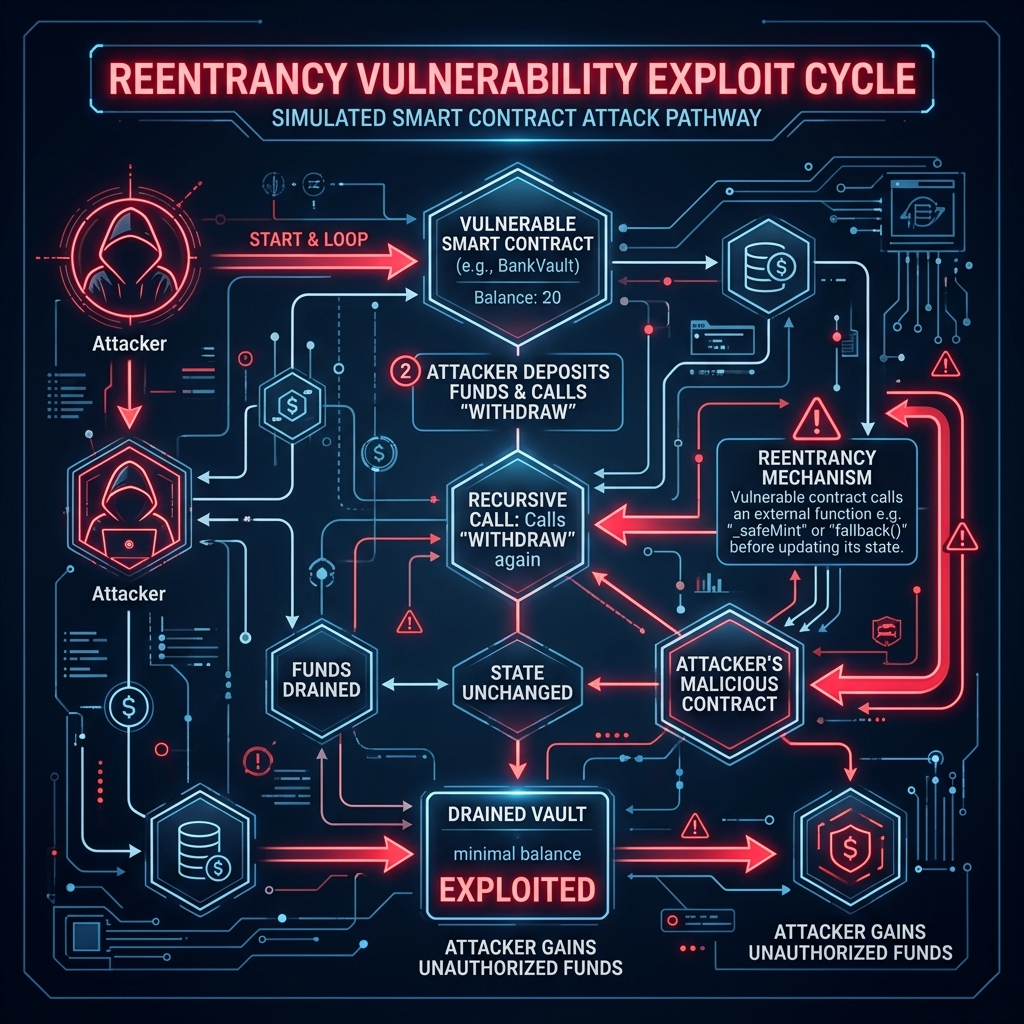
    The Code-Free Analogy: The Bank Teller Loop

    To understand reentrancy mechanically, imagine you walk into a traditional physical bank to withdraw $100 from your account, which has a balance of $100. The withdrawal protocol should look like this:

    1. You request the withdrawal.
    2. The teller checks your balance ($100).
    3. The teller gives you the cash ($100).
    4. The teller updates your balance ledger to $0.

    Now, imagine a flaw in the teller’s instructions: they give you the cash first, and only update the ledger afterwards.

    An attacker exploits this flaw by using a trick:

    • The attacker requests a withdrawal of $100.
    • The teller verifies the balance ($100) and hands the attacker the cash.
    • Before the teller can reach for the pen to update the ledger, the attacker immediately calls out: “Wait, I want to withdraw another $100!”
    • Because the teller has not updated the ledger yet, the book still says the attacker has $100. The teller checks the book, sees $100, hands over another $100 cash, and is interrupted again.
    • This loop repeats recursively until the bank’s vault is entirely empty.

    In smart contracts, this is called reentrancy. The external contract (the attacker) interrupts the execution flow of the victim contract (the bank) by recursively calling the withdraw function before the victim contract can update its internal state balance ledger.


    The Solidity Mechanics: Withdraw-Before-Update

    In Solidity (Ethereum’s primary programming language), this exploit is caused by violating the Checks-Effects-Interactions pattern. A vulnerable contract function looks like this:

    
    // VULNERABLE CODE EXAMPLE
    function withdraw() public {
        uint256 bal = userBalances[msg.sender];
        require(bal > 0);
        
        // Interaction: sending ether to msg.sender triggers fallback
        (bool success, ) = msg.sender.call{value: bal}("");
        require(success);
        
        // Effect: updating the balance occurs AFTER the interaction!
        userBalances[msg.sender] = 0;
    }
    

    An attacking contract implements a fallback function. When the victim contract calls msg.sender.call, execution transfers to the attacker’s fallback function, which calls withdraw() again. Because userBalances[msg.sender] has not been set to 0 yet, the transaction checks pass, and more ether is sent. The loop only terminates when gas runs out or the victim contract is empty.


    How Users Can Audit and Protect Against Reentrancy Risk

    While reentrancy is a developer-level coding error, DeFi users bear 100% of the financial risk. You can protect your capital by checking these key details:

    1. Audit for Reentrancy Guards

    Secure protocols utilize OpenZeppelin’s standard ReentrancyGuard contract libraries. This adds a modifier called nonReentrant to functions. This modifier acts as a lock: it prevents a function from being entered recursively. Before depositing funds, verify if the protocol’s audit reports specifically state: “Reentrancy guards are correctly implemented on all public deposit/withdrawal interfaces.”

    2. Avoid Insecure Forks

    Many DeFi exploits happen to “forks”—new platforms that copy the code of established protocols like Uniswap or Compound but make minor changes or deploy on new chains. Developers copying code often forget to implement matching security modifiers, leaving the new protocol open to reentrancy exploits.


    Monitoring DeFi Threats with XTSG

    Because smart contract exploits happen in real-time, manual code auditing is not enough for active DeFi traders. You need live telemetry.

    The XTSG On-Chain Risk Dashboard is designed to provide this warning system:

    • Active Exploit Detection: The dashboard monitors public mempools (where transactions wait to be processed) for abnormal recursive function calls or flash loan patterns. If a reentrancy attack begins on a protocol you are using, the system alerts you immediately.
    • Contract Safety Scores: Search any protocol address on XTSG to get a comprehensive safety report, highlighting whether reentrancy guards are present and detailing their multi-signature threshold status.

    Before you deposit funds into any pool, verify the contract safety on XTSG. Keep your long-term capital isolated, audit audit reports, and stay ahead of on-chain exploits.


  • Smart Contract Exploit Prevention: A DeFi User’s Guide

    Smart Contract Exploit Prevention: A DeFi User’s Guide

    Decentralized Finance (DeFi) has unlocked unprecedented financial utility, allowing users to lend, borrow, and trade assets without middlemen. But this open, composable structure carries a massive threat surface. Unlike traditional banks where funds are secured by legal insurance and server firewalls, DeFi deposits are secured solely by code. If a protocol’s smart contract contains a logical bug, hackers can drain the entire liquidity pool in seconds.

    For DeFi participants, smart contract exploit prevention is a vital skill. In this guide, we will walk through the most common smart contract exploit vectors—including reentrancy, oracle manipulation, and flash loan attacks—and outline the practical steps you can take to protect your funds before interacting with any decentralized protocol.


    Under the Hood: The Most Common DeFi Exploit Vectors

    Smart contract exploits are not traditional database hacks. The hacker does not guess administrative passwords; they interact with the public functions of the contract in ways the developer did not anticipate. Here are the three primary methods:

    1. Reentrancy Attacks

    A reentrancy attack occurs when a smart contract sends funds to an untrusted external contract before updating its internal state balance. The external contract (controlled by the attacker) executes a fallback function that calls the withdraw function again, recursively draining the contract’s funds before the first transaction can update the balance ledger. The classic DAO hack of 2016 is the most famous example of this vector.

    2. Oracle Manipulation

    Many DeFi lending platforms rely on decentralized oracles to determine the real-time price of assets (such as collateral). If a platform reads the price from a single, low-liquidity pool, an attacker can borrow massive capital, artificially inflate the price of a token in that specific pool, use their inflated tokens as collateral to borrow other valuable assets, and then leave the protocol with bad debt.

    3. Flash Loan Attacks

    Flash loans allow anyone to borrow millions of dollars in crypto without collateral, provided the loan is repaid within the exact same blockchain transaction. Attackers combine flash loans with oracle manipulation or contract balance exploits, acquiring vast capital to force pricing inefficiencies in a single block and walking away with risk-free profit.


    Step-by-Step: How Users Can Prevent Exploit Exposure

    While users cannot rewrite a protocol’s smart contract, they can perform simple security audits to identify high-risk platforms. Before depositing capital, run through this checklist:

    1. Check Audit Records: Never deposit funds into an unaudited protocol. Verify that the contracts have been reviewed by reputable security firms (e.g. CertiK, OpenZeppelin, Trail of Bits). Multiple audits from different firms are a strong indicator of safety.
    2. Review Multi-Signature Governance: Verify who controls the protocol’s upgrade keys. If a single developer wallet can modify the contract code without a multi-signature threshold or a timelock delay, the protocol is highly vulnerable to a rug-pull or single-point-of-failure hack.
    3. Audit Total Value Locked (TVL) vs. Domain Age: Scams and vulnerable forks often buy fake volume. If a protocol has $50 million in TVL but its domain was registered two weeks ago, it is highly likely to be a honey-pot or an insecure copy of another protocol.
    4. Limit Token Approvals: When approving a protocol, never grant unlimited access to your wallet’s entire balance. Only approve the exact amount of tokens you plan to deposit, and revoke the approval using Etherscan or Revoke.cash when you exit.

    Hands-On Sandbox Testing with XTSG

    Analyzing smart contract risk theoretically is important, but practical experience is far more effective. This is why we created the XTSG Smart Contract Threat Simulation Terminal.

    The simulation terminal is a safe, sandboxed environment where users can:

    • Run Exploit Scenarios: Execute simulated reentrancy, oracle manipulation, and flash loan attacks against dummy contracts to see exactly how funds are drained on-chain.
    • Inspect Transaction Payloads: Study what a malicious transaction payload looks like in your wallet interface before you sign it. Learning to spot these variables is the most effective way to prevent signing bad transactions.
    • Verify Contract Code: Test copy-pasted smart contract addresses against XTSG’s automated auditor to parse for logical flaws and owner privileges.

    DeFi offers incredible yield opportunities, but it requires a defensive mindset. Audit every protocol, run test scenarios in the XTSG simulator, and limit your wallet approvals to protect your hard-earned capital.

  • How to Revoke Smart Contract Approvals Safely

    How to Revoke Smart Contract Approvals Safely

    If you have traded on a decentralized exchange, minted an NFT, or deposited tokens into a yield farm, you have signed a transaction approval. In most Web3 interfaces, platforms default to requesting “unlimited approval” to spend your tokens. This is designed to save you gas fees on subsequent trades. However, it also creates a massive security loophole. If that protocol is ever exploited, or if the developers perform an exit-rug, every wallet that has an active allowance can be drained of its tokens, even if they are stored offline.

    To secure your wallet, you must know how to perform a revoke smart contract approval process. In this step-by-step guide, we will explain exactly what smart contract approvals are, why legacy allowances are a silent security threat, and how to verify and revoke them using public blockchain tools.


    What Is a Smart Contract Approval?

    Unlike traditional databases, smart contracts cannot automatically withdraw tokens from your wallet address. To swap tokens on Uniswap or stake funds in a pool, you must first authorize the protocol’s smart contract to interact with your balance. This is done through standard ERC-20 token standards using two main functions:

    1. approve(address spender, uint256 amount): Authorizes a specific contract (spender) to withdraw up to a designated amount of tokens from your wallet.
    2. setApprovalForAll(address operator, bool approved): Used in NFT contracts (ERC-721/1155). This grants the operator permission to transfer all NFTs of that specific collection out of your wallet.

    When you click “Approve” in MetaMask or Rabby, you are writing an immutable record on the blockchain that says: “This contract address is allowed to spend my tokens.”


    Why Legacy Approvals Are a Silent Security Threat

    Many users assume that disconnecting their wallet from a Web3 site revokes approvals. This is incorrect. Disconnecting simply tells the frontend site to stop reading your public address. The approval record remains active on the blockchain ledger forever.

    This creates two major vulnerabilities:

    • Protocol Exploits: If a protocol you used three years ago has a vulnerability in its smart contract code, hackers can exploit that contract to call the transferFrom() function. Since you granted that contract an unlimited allowance, the hacker can drain your tokens directly from your wallet. This is exactly how the Multichain and SushiSwap Router exploits drained millions from offline wallets.
    • Phishing Drainers: Phishing sites are designed to mimic legitimate swap interfaces but display a transaction prompt requesting approval for a malicious contract address. Once you sign the approval, the drainer script instantly transfers your assets.

    Step-by-Step Guide: How to Revoke Approvals

    You can revoke approvals using dedicated revocation portals or block explorer tools. Here is how to clean up your wallet approvals safely.

    Method 1: Revoking via Revoke.cash

    Revoke.cash is the gold-standard interface for allowance auditing. It supports dozens of EVM chains and is highly intuitive.

    1. Navigate to the official Revoke.cash portal.
    2. Connect your hot or cold wallet (MetaMask, Rabby, Ledger).
    3. Audit the list of active approvals. It will show the token, the spender contract, the approved allowance (e.g. “Unlimited” or a specific amount), and the total asset exposure.
    4. Click the “Revoke” button next to any unneeded approval.
    5. Confirm the transaction signature in your wallet. This writes a new blockchain transaction resetting the allowance to 0.

    Method 2: Revoking via Block Explorers (Etherscan Token Approval Checker)

    If you want to avoid third-party interfaces, you can interact directly with Etherscan or other chain explorers.

    1. Go to Etherscan and select More -> Tools -> Token Approvals.
    2. Connect your Web3 wallet.
    3. Inspect the tabs for ERC-20, ERC-721, and ERC-1155.
    4. Click the Revoke button next to the spender address and sign the transaction in your wallet.

    Advanced Defense: Pair Revocation with XTSG Threat Monitoring

    Auditing and revoking approvals is a critical hygiene habit, but it is reactive. If you approve a smart contract that gets hacked five minutes later, manual auditing will be too slow. This is where the XTSG On-Chain Risk Dashboard comes in.

    By connecting your wallet to the XTSG monitoring suite, you establish an automated safeguard:

    • Pre-Sign Verifications: Before you approve any smart contract transaction, check the XTSG dashboard to verify the contract’s safety history and identify if it is a known malicious address.
    • Exploit Alerts: The dashboard monitors your active approvals in real-time. If an active exploit is detected on a smart contract you are approved to, the system will trigger a high-priority alert, prompting you to revoke the approval instantly before the exploit reaches your address.

    Keep your wallet clean and isolated. Use Etherscan or Revoke.cash to scrub your approvals monthly, and monitor active protocols with XTSG to maintain a complete Web3 security posture.