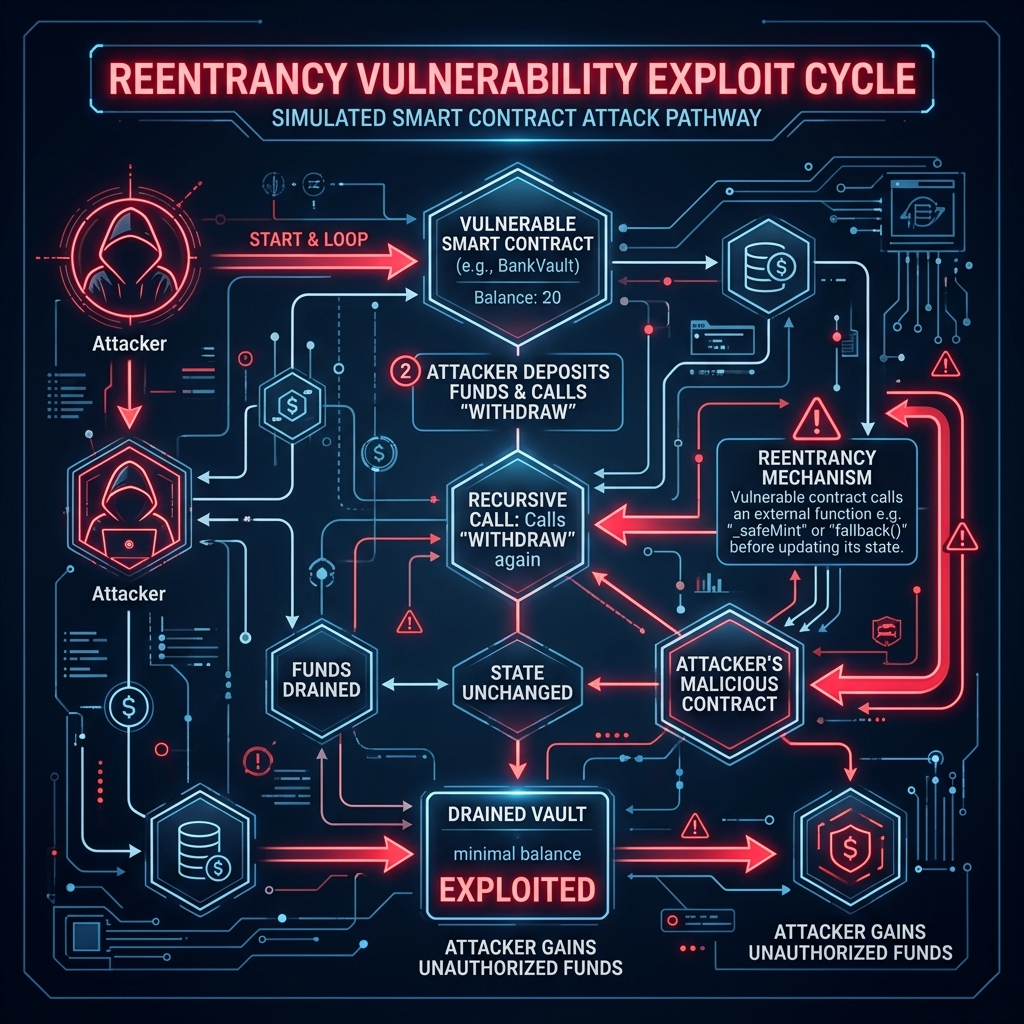
In the history of blockchain exploits, one vulnerability stands out as the most historically significant and economically damaging: the reentrancy attack. It was the exact vector used in 2016 to drain 3.6 million Ether from The DAO, forcing the Ethereum network to execute a controversial hard fork that split the chain into Ethereum (ETH) and Ethereum Classic (ETC). Even in 2026, reentrancy remains a common vulnerability in new Solidity smart contracts.
For DeFi users and Web3 developers, understanding this vector is crucial. In this guide, we will break down what a reentrancy attack defi vector is, explain its mechanics using a simple code-free analogy, review real-world hacks, and explain how you can protect your assets before interacting with protocols.
The Code-Free Analogy: The Bank Teller Loop
To understand reentrancy mechanically, imagine you walk into a traditional physical bank to withdraw $100 from your account, which has a balance of $100. The withdrawal protocol should look like this:
- You request the withdrawal.
- The teller checks your balance ($100).
- The teller gives you the cash ($100).
- The teller updates your balance ledger to $0.
Now, imagine a flaw in the teller’s instructions: they give you the cash first, and only update the ledger afterwards.
An attacker exploits this flaw by using a trick:
- The attacker requests a withdrawal of $100.
- The teller verifies the balance ($100) and hands the attacker the cash.
- Before the teller can reach for the pen to update the ledger, the attacker immediately calls out: “Wait, I want to withdraw another $100!”
- Because the teller has not updated the ledger yet, the book still says the attacker has $100. The teller checks the book, sees $100, hands over another $100 cash, and is interrupted again.
- This loop repeats recursively until the bank’s vault is entirely empty.
In smart contracts, this is called reentrancy. The external contract (the attacker) interrupts the execution flow of the victim contract (the bank) by recursively calling the withdraw function before the victim contract can update its internal state balance ledger.
The Solidity Mechanics: Withdraw-Before-Update
In Solidity (Ethereum’s primary programming language), this exploit is caused by violating the Checks-Effects-Interactions pattern. A vulnerable contract function looks like this:
// VULNERABLE CODE EXAMPLE
function withdraw() public {
    uint256 bal = userBalances[msg.sender];
    require(bal > 0);

    // Interaction: sending ether to msg.sender triggers fallback
    (bool success, ) = msg.sender.call{value: bal}("");
    require(success);

    // Effect: updating the balance occurs AFTER the interaction!
    userBalances[msg.sender] = 0;
}
An attacking contract implements a fallback function. When the victim contract calls msg.sender.call, execution transfers to the attacker’s fallback function, which calls withdraw() again. Because userBalances[msg.sender] has not been set to 0 yet, the transaction checks pass, and more ether is sent. The loop only terminates when gas runs out or the victim contract is empty.
How Users Can Audit and Protect Against Reentrancy Risk
While reentrancy is a developer-level coding error, DeFi users bear 100% of the financial risk. You can protect your capital by checking these key details:
1. Audit for Reentrancy Guards
Secure protocols utilize OpenZeppelin’s standard ReentrancyGuard contract libraries. This adds a modifier called nonReentrant to functions. This modifier acts as a lock: it prevents a function from being entered recursively. Before depositing funds, verify if the protocol’s audit reports specifically state: “Reentrancy guards are correctly implemented on all public deposit/withdrawal interfaces.”
2. Avoid Insecure Forks
Many DeFi exploits happen to “forks”—new platforms that copy the code of established protocols like Uniswap or Compound but make minor changes or deploy on new chains. Developers copying code often forget to implement matching security modifiers, leaving the new protocol open to reentrancy exploits.
Monitoring DeFi Threats with XTSG
Because smart contract exploits happen in real-time, manual code auditing is not enough for active DeFi traders. You need live telemetry.
The XTSG On-Chain Risk Dashboard is designed to provide this warning system:
- Active Exploit Detection: The dashboard monitors public mempools (where transactions wait to be processed) for abnormal recursive function calls or flash loan patterns. If a reentrancy attack begins on a protocol you are using, the system alerts you immediately.
- Contract Safety Scores: Search any protocol address on XTSG to get a comprehensive safety report, highlighting whether reentrancy guards are present and detailing their multi-signature threshold status.
Before you deposit funds into any pool, verify the contract safety on XTSG. Keep your long-term capital isolated, audit audit reports, and stay ahead of on-chain exploits.
Leave a Reply